
Brittle, Damaged Hair? The Davines Nourishing Routine, Step by Step
Damaged hair is usually pretty easy to spot. It breaks when you brush it, tangles more than it should, feels dry through the ends, and no matter how many products you use, it never seems to feel truly soft or healthy again. Whether it's been damaged by heat styling, colouring, or just everyday wear and tear, the solution is the same: nourish it, strengthen it, and lock that moisture in. The Davines Nourishing routine is what we recommend when hair needs genuine repair, not just a temporary fix.
What damage actually is
Picture a single hair as a rope inside a protective sleeve. The sleeve is the cuticle, those overlapping scales on the outside, and the rope is the cortex, the strong inner core. Healthy hair has a smooth, closed cuticle and a strong cortex, so it stretches and springs back.
Damage works on both layers. It lifts and chips away at the cuticle, so moisture escapes and the surface feels rough, and it weakens the bonds inside the cortex, so the hair loses its stretch and snaps instead of bouncing back. That is why damaged hair feels dry, rough and fragile all at once. Repair has to do two jobs, put moisture back and rebuild strength, which is why one product on its own rarely cuts it.
What causes the damage
Most damaged hair is the result of a few things stacking up.
Colour and bleach are the big ones, especially lightening, which has to open the cuticle and break things down to lift colour out. Heat tools used too hot or too often roughen and weaken the hair over time, particularly without a heat protectant. Everyday wear and tear plays its part: rough brushing, tight ties, and scrubbing wet hair with a towel. And the quieter culprits, hard water, sun and simply time, slowly chip away in the background.
Knowing your main cause helps, because it tells you what to change as well as what to use.
The mistakes that slow repair
A few habits undo the good work. Brushing wet hair hard, when it is at its most fragile, snaps it. Use a wide-tooth comb or a wet brush and start at the ends. Cranking the straightener to its highest heat feels efficient and does real damage, so dial it back. And skipping the sealing step, which we will get to, lets all the moisture you have just added walk straight back out.
The five-step Nourishing routine
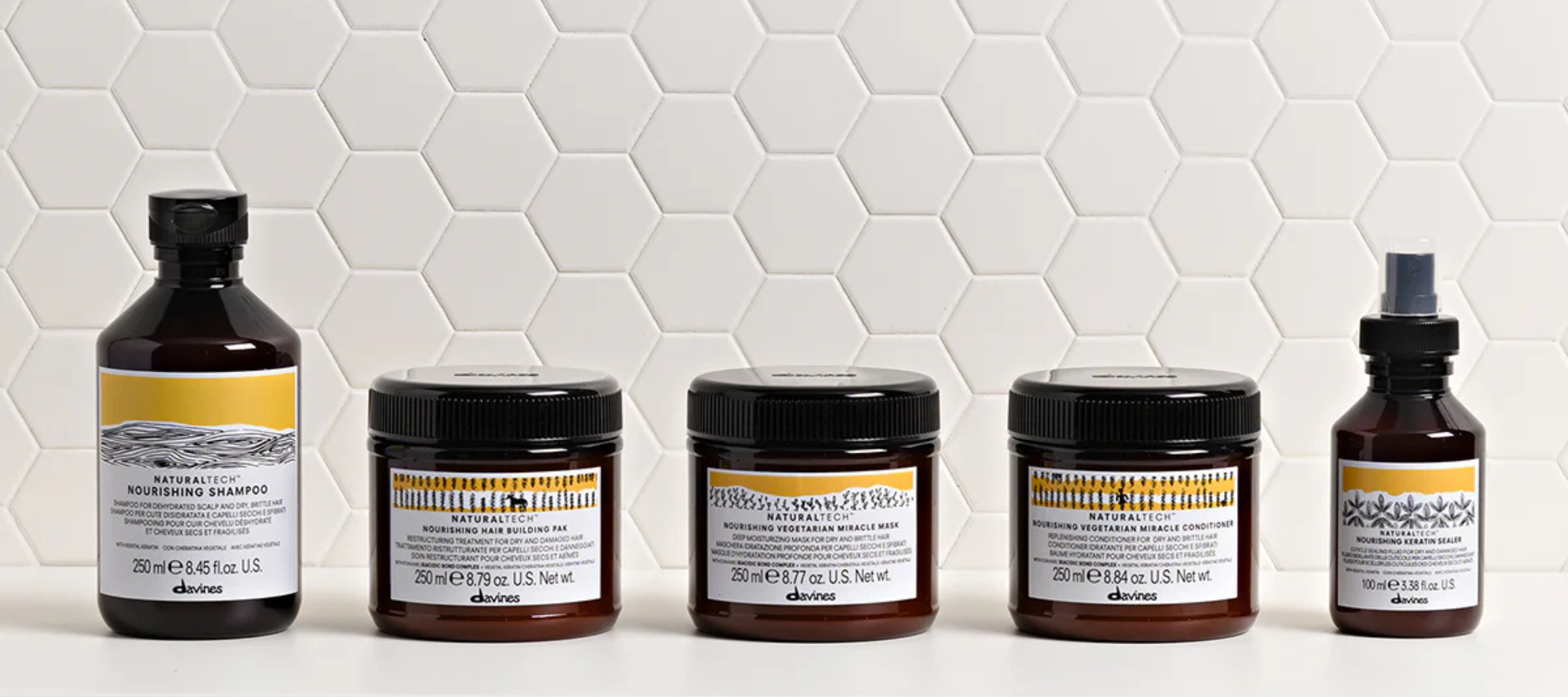
The Davines NaturalTech Nourishing range is built as a routine, and each step has a job.
Start with the Davines Nourishing Shampoo, which cleanses gently and gives thirsty, dry hair its first proper drink. Follow with the Davines Nourishing Vegetarian Miracle Conditioner, a detangling, softening step made for fragile lengths.
Once a week, swap the conditioner for the Davines Nourishing Vegetarian Miracle Mask, a deeper treatment for hair that needs more. For hair that is genuinely weak and snapping, add the Davines Nourishing Hair Building Pak, a reconstructing treatment that restructures the hair, salon-level repair you can do at home.
Finish with the Davines Nourishing Keratin Sealer, a leave-in fluid that seals everything you have just put in so it actually lasts. That last step is the one people skip, and it is the one that locks in the results.
How to use them together
For everyday, that is shampoo, conditioner and sealer. Once a week, bring in the mask in place of your conditioner. When hair is badly damaged, work the Building Pak in before your mask for a week or two, until the hair starts to feel stronger, then drop back to maintenance. Keep the conditioner, mask and sealer focused on the mid-lengths and ends, where the damage lives, and off the scalp.
Be patient, and realistic
Here is the honest part: repaired hair is not the same as brand new hair. A good routine genuinely improves how damaged hair looks, feels and behaves, but the most damaged sections are best grown out and trimmed off over time. So you are doing two things at once, nursing the hair you have back to health while you grow the worst of it out. Keep heat tools sensible in the meantime, book in regular small trims, and the change over a few months is real.
If your hair is also coloured or fine
Coloured hair is often damaged hair, so this range sits nicely alongside a colour routine, and the moisture it adds helps colour look glossier. If your hair is fine as well as damaged, go lighter on the mask and pak so you do not overload it, and lean on the sealer for everyday smoothing.
Damaged hair FAQs
How often should I use the mask? Once a week is plenty for most people. Badly damaged hair can handle twice a week for a short stretch.
Can damage actually be repaired, or only hidden? A bit of both, honestly. Good products genuinely strengthen and smooth the hair, but they cannot rebuild it indefinitely. Regular trims are part of the fix.
Do I still need the sealer if I use the mask? Yes. The mask feeds the hair, the sealer locks it in. They do different jobs.
Will this weigh my hair down? Not if you keep it off the roots and match the richness to your hair. Fine hair, go lighter; coarse hair, be more generous.
Let us take a look
If you are not sure how damaged your hair really is, or which steps you actually need, we can help. Email Aurea at hello@sable.co.nz to talk it through, or book in so our team can assess it in person and get you on the right routine. While you are repairing, our guide to smoothing frizzy hair pairs well, since damage and frizz so often travel together.
Ready to repair? Shop the Davines NaturalTech range at Sable Boutique, with Afterpay and Zip.